Grid Unit
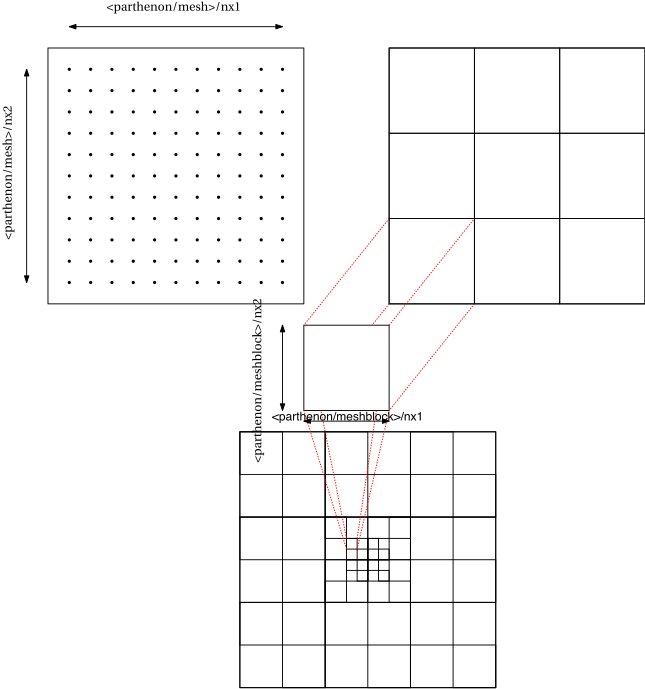
Kamayan is built on parthenon's grid, which can support uniform, static
and adaptively refined meshes as a runtime option. The domain is initialized
as a uniform grid of nx1xnx2xnx3 cells. These can then be
partitioned onto an initial grid of MeshBlocks, which can be further
refined based on various conditions. See Parameters for more
details on the runtime parameters that control this behavior.
Fields
Kamayan strongly prefers to reference field data stored on the MeshBlocks through
the type based interface. Fields are associated with a struct, and instantiations
of that type can be used to reference a desired element of that field if it
is declared with some tensor shape. Kamayan exports all possible fields in
kamayan/fields.hpp, but which fields have been registered to the simulation
will depend on the configuration of the various units. Here fields are declared
with the VARIABLE macro, which takes in the type name in all capital letters,
which also serves as the string label associated with the field, and optionally
a list of ints that will become the tensor shape of the field when registered
with the kamayan::AddField[s] interfaces.
// conserved variables
using DENS = VariableBase<"dens">;
// will register with shape=std::vector<int>{3}
using MOMENTUM = VariableBase<"momentum", VariableRank::vector, 3>;
using ENER = VariableBase<"ener">;
using MAG = VariableBase<"mag">;
Note
KamayanUnits will register fields through the Initialize callback interface
that returns a StateDescriptor.
Packs
Field data can be accessed through the SparsePacks
provided by parthenon that will pack variables by type into a single data structure
that can be used to index into cell level data on MeshBlocks and MeshData
partitions. Kamayan provides an interface to directly get these packs, either
directly through listing explicitly the desired variables or by passing a
TypeList of the variable structs you wish to access.
physics/hydro/hydro_add_flux_tasks.cpp:pack
// explicitly specify the fields we want
  auto pack = grid::GetPack<DENS, VELOCITY, PRES, MAGC>(mb);
// packing with a decl'ed `TypeList` from the HydroTraits
    auto pack_recon = grid::GetPack(reconstruct_vars(), md);
    // include Xf for cylindrical geometry flux corrections
    using flux_vars = ConcatTypeLists_t<conserved_vars, grid::Xface>;
    auto pack_flux = grid::GetPack(flux_vars(), md, {PDOpt::WithFluxes});
Note
Additional pack options can be specified. In this example the PDOpt::WithFluxes
option means that the associated fluxes if any for the packed variables will
also be accessible with the pack_flux.flux interface.
Packs can then be indexed by block, variable and (k,j,i) index
        pack(0, DENS(), k, j, i) = state(DENS());
        pack(0, PRES(), k, j, i) = state(PRES());
        pack(0, VELOCITY(0), k, j, i) = state(VELOCITY(0));
        pack(0, VELOCITY(1), k, j, i) = state(VELOCITY(1));
        pack(0, VELOCITY(2), k, j, i) = state(VELOCITY(2));
Subpacks
Often we don't need full access to all block, and cell indices of the pack. Rather it is advantageous only worry about a relative offset along the dimensions of interest for a particular function. Some examples are the conversion of primitive to conservative variables, which only cares about indexing into different fields at the same cell, or the reconstruction of Riemann states, which need only to index into the same field at neighboring zones along a one dimensional stencil.
Kamayan provides the SubPack abstractions to wrap packs and
Kokkos::Views to do just that.
          auto U = SubPack(pack, b, k, j, i);
          Prim2Cons<hydro_traits>(U, U);
  U(DENS()) = V(DENS());
  Real emag = 0.;
  Real ekin = 0.;
  for (int dir = 0; dir < 3; dir++) {
    U(MOMENTUM(dir)) = V(DENS()) * V(VELOCITY(dir));
    ekin += V(VELOCITY(dir)) * V(VELOCITY(dir));
    if constexpr (hydro_traits::MHD != Mhd::off) {
      U(MAGC(dir)) = V(MAGC(dir));
      emag += V(MAGC(dir)) * V(MAGC(dir));
    }
  }
                auto stencil = SubPack<Axis::IAXIS>(pack_recon, b, var, k, j, i);
                Reconstruct<reconstruction_traits>(stencil, vM(var, i), vP(var, i));
  const Real dvL = stencil(0) - stencil(-1);
  const Real dvR = stencil(1) - stencil(0);
Scratch Variables
Kamayan provides the ability to represent fields on the mesh that are temporary
in nature using collections called ScratchVariableLists. These provide types that
can be registered to a package that will alias common Metadata::derived fields
across different regions where they are used. In this way temporary block storage is
achieved without needing to allocate more memory than is minimally required to
satisfy a single ScratchVariableList.
ScratchVarableLists are constructed from specializations of the ScratchVariable
type that is used to describe the variable's TopologicalType and vector/tensor shape,
and finally are used to index into the ScratchVariableList in order to get a type
that can be used exactly as any other field through the type-based packing.
// first-order derivative at centers used in Loehner estimator
using FirstDer = RuntimeScratchVariable<"firstder", TopologicalType::Cell, 3>;

using RefinementScratch = RuntimeScratchVariableList<FirstDer>;
In the above example a single scratch variable to represent the first-order
derivatives in each 3D direction is registered as a cell centered variable as a
3 component vector. When it is registered it will define three fields,
scratch_cell_n, that can be reused by other scratch variables, possibly of different
shape.
The alias FirstDer is pulled out of the ScratchVariableList can then be used with the pack overloads just like any other field.
        pack_der(b, 0, k, j, i) =
            0.5 * (pack(b, var, k, j, i + 1) - pack(b, var, k, j, i - 1)) /
            coords.Dxc<1>();
Note
If cmake is configured with -Dkamayan_DEBUG_SCRATCH then each scratch variable
will be independently registered using the name string template parameter
to the ScratchVariable. In the above example a shape {3} field
scratch_firstder will be registered.
Coordinates
Kamayan builds on Parthenon's mesh and coordinate layout (currently
parthenon::UniformCartesian), but wraps it behind a small geometry layer so that
code can be written against a consistent coordinate/metric API while the geometry
is selected at runtime.
At the moment the grid unit supports:
Geometry::cartesian: standard 1D/2D/3D CartesianGeometry::cylindrical: 2D axisymmetric r-z with an implicit azimuthal direction (the third direction usesdphi = 2*pi)
CoordinateSystem
The coordinate wrappers implement the CoordinateSystem concept
(src/grid/geometry.hpp), which is the practical "contract" used throughout the code.
It includes both compile-time and runtime axis dispatch:
- Compile-time:
template <Axis ax> Dx(),Xc(idx),Xf(idx),FaceArea(k,j,i), ... - Runtime:
Dx(Axis),Xc(Axis, idx),Xf(Axis, idx),FaceArea(Axis,k,j,i), ...
The main coordinate wrapper is grid::Coordinates<geom> (src/grid/geometry.hpp). It is
a thin layer over Parthenon's coordinates that provides geometry-specific fixes for
metric factors:
X/Xi: coordinate at the Parthenon cell-center locationXc: coordinate at the cell centroid (differs fromXifor cylindrical r)-
Xf: coordinate at the face location -
In Cartesian geometry, methods delegate to Parthenon.
- In cylindrical geometry:
Dx<Axis::KAXIS>()returns2*pi(implicit azimuthal direction)Xc<Axis::IAXIS>(idx)computes the radial centroid of the cell (not just the midpoint);Xi<Axis::IAXIS>(idx)remains the "cell center" value from ParthenonFaceArea,EdgeLength, andCellVolumeuse r-z metric factors (e.g.V = 0.5 * dphi * (r_{i+1/2}^2 - r_{i-1/2}^2) * dz)
CoordinatePacks
Parthenon's coordinate methods are largely inline calculations. For geometry-dependent
metric factors (areas, volumes, centroids, etc.) it is often cheaper and simpler to
precompute them once per MeshBlock and store them as normal fields.
The grid unit registers and fills these coordinate fields:
- Field types live in
src/grid/coordinates.hppunderkamayan::grid::coords::*and the full list isgrid::CoordFields. - The fields are allocated with geometry-aware degenerate shapes via
grid::CoordinateShape: - Cartesian:
Dx*,FaceArea*,EdgeLength*,Volumeare scalars;X*,Xc*,Xf*are 1D arrays per-axis. - Cylindrical:
Dx*are scalars; r-dependent quantities (Volume,FaceArea*,EdgeLength*, andX*/Xc*/Xf*for r) are stored as 1D arrays in the radial direction. grid::CalculateCoordinates(src/grid/coordinates.cpp) fills allCoordFieldsfor each block (usinggrid::CoordinateIndexRangesto respect degenerate/face extents), and is called from the grid unit'sInitMeshBlockDatacallback.
grid::CoordinatePack<geom, ...> (src/grid/coordinates.hpp) wraps a SparsePack holding
these geom.* fields and exposes the same API as grid::Coordinates<geom> but indexed by
(k,j,i). Internally it maps (k,j,i) onto the degenerate storage layout (scalar/1D), so
call sites do not need to care about how each metric is stored.
Example usage (runtime geometry):
        auto cp = grid::GenericCoordinatePack(geometry, cpack, 0);
        const Real x1 = cp.template Xc<Axis::IAXIS>(k, j, i);
        const Real x2 = cp.template Xc<Axis::JAXIS>(k, j, i);
Generic Coordinates (Packs)
When the geometry is only known at runtime, Kamayan provides variant-based wrappers:
grid::GenericCoordinate(src/grid/geometry.hpp) wrapsgrid::Coordinates<geom>in avariantand forwards calls viavisit.grid::GenericCoordinatePack(src/grid/coordinates.hpp) does the same forgrid::CoordinatePack<geom, ...>.
In practice GenericCoordinatePack is constructed from a coordinate-field pack (e.g.
grid::GetPack(grid::CoordFields(), ...)) and then used like a normal coordinate object.
These are convenient in code like problem generators, but they do add a small overhead
compared to templating on Geometry. For performance-critical kernels prefer templating
on geom and constructing the matching grid::Coordinates<geom>/grid::CoordinatePack<geom>.
Parameters
| Paramter | Type | Default | Allowed | Description |
|---|---|---|---|---|
| <debug> | ||||
| ndebug | Integer | 0 | Number of debug fields to allocate at CC. | |
| <geometry> | ||||
| geometry | String | cartesian | [ cartesian, cylindrical, ] | grid geometry |
| <kamayan/refinement> | ||||
| nref_vars | Integer | 1 | Parameter determined at runtime for the number of registered refinement fields. Never any reason to be set. | |
| <kamayan/refinement0> | ||||
| derefine_tol | Real | 2.00000e-01 | Error threshold for derefinement | |
| field | String | dens | Field to refine on. | |
| filter | Real | 1.00000e-02 | Noise filtering strength used in Loehner estimator. | |
| max_level | Integer | 1 | max refinement level for this field. | |
| method | String | loehner | [ loehner, derivative_order_1, derivative_order_2, ] | Method to use for refinement |
| refine_tol | Real | 8.00000e-01 | Error threshold for refinement | |
| <parthenon/mesh> | ||||
| ix1_bc | String | outflow | [ periodic, outflow, reflect, user, axisymmetric, ] | Inner boundary condition along x1. |
| ix2_bc | String | outflow | [ periodic, outflow, reflect, user, ] | Inner boundary condition along x2. |
| ix3_bc | String | outflow | [ periodic, outflow, reflect, user, ] | Inner boundary condition along x3. |
| nghost | Integer | 2 | Number of ghost zones to use on each block. | |
| numlevel | Integer | 1 | Number of refinement levels. | |
| nx1 | Integer | 32 | Number of cells across the domain at level 0. | |
| nx2 | Integer | 32 | Number of cells across the domain at level 0. Set to 1 for 1D. | |
| nx3 | Integer | 32 | Number of cells across the domain at level 0. Set to 1 for 2D. | |
| ox1_bc | String | outflow | [ periodic, outflow, reflect, user, ] | Outer boundary condition along x1. |
| ox2_bc | String | outflow | [ periodic, outflow, reflect, user, ] | Outer boundary condition along x2. |
| ox3_bc | String | outflow | [ periodic, outflow, reflect, user, ] | Outer boundary condition along x3. |
| refinement | String | adaptive | [ adaptive, static, none, ] | Mesh refinement strategy. |
| x1max | Real | 1.00000e+00 | Maximum x1 value of domain. | |
| x1min | Real | 0.00000e+00 | Minimum x1 value of domain. | |
| x2max | Real | 1.00000e+00 | Maximum x2 value of domain. | |
| x2min | Real | 0.00000e+00 | Minimum x2 value of domain. | |
| x3max | Real | 1.00000e+00 | Maximum x3 value of domain. | |
| x3min | Real | 0.00000e+00 | Minimum x3 value of domain. | |
| <parthenon/meshblock> | ||||
| nx1 | Integer | 16 | Size of meshblocks in x1. | |
| nx2 | Integer | 16 | Size of meshblocks in x2. | |
| nx3 | Integer | 16 | Size of meshblocks in x3. |